
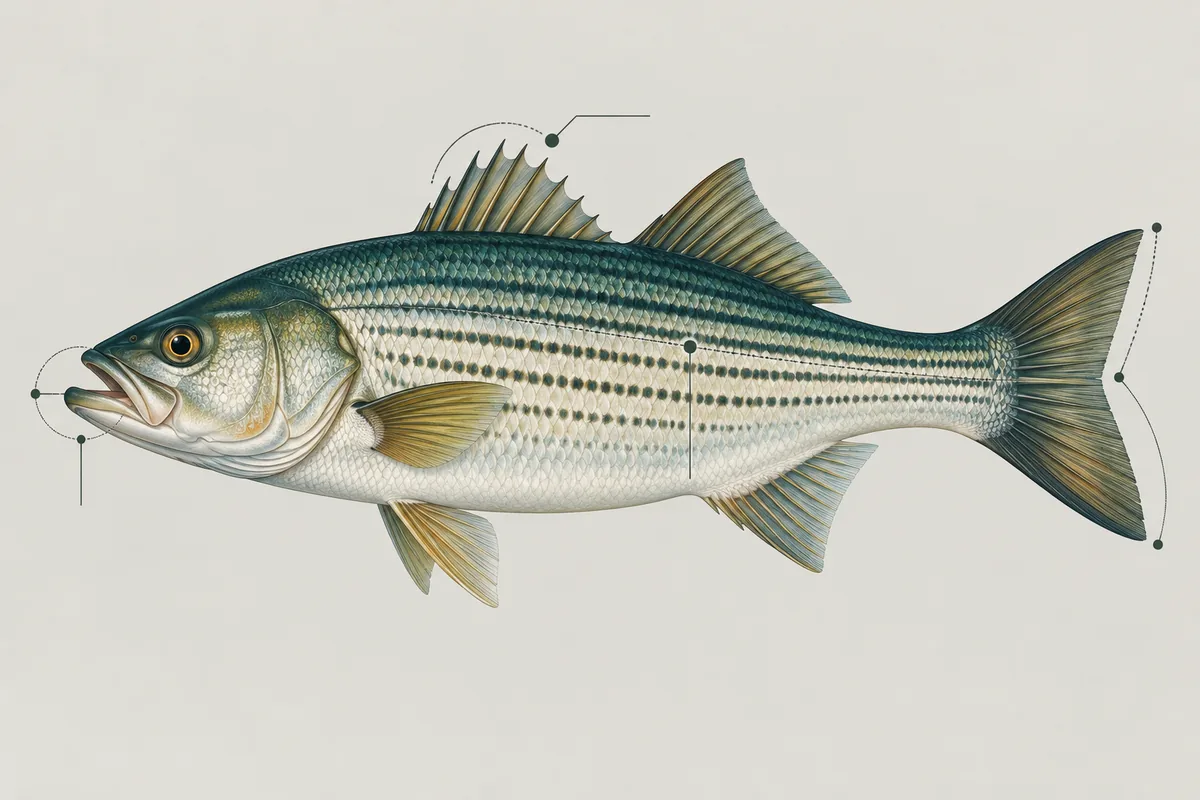
Start with the photo tool
If you have a clear image, Fish Identifier can suggest a likely species, visible clues, lookalikes, and a next step. Use that result as a starting point, then apply the field-guide method below when the name matters.
1 · Record the setting
Start with context before a fish species name
Before you compare photographs or search a database, write down the broad context. Note the country or region, the nearest water body, whether the water is fresh, brackish, or marine, and the habitat you could actually see. A river riffle, muddy pond edge, quiet lake shore, seagrass bed, or coral reef can make different candidates plausible. Context narrows the list; it does not prove a species.
Record how the fish was observed. Was it swimming in open water, resting near the bottom, hiding in vegetation, attached to a structure, or photographed in an aquarium? If you have a photo, keep the original file and note the date, approximate location, depth or water temperature when known, and whether the fish was a juvenile or breeding adult.
2 · Describe stable traits
Read the body, mouth, and surface features
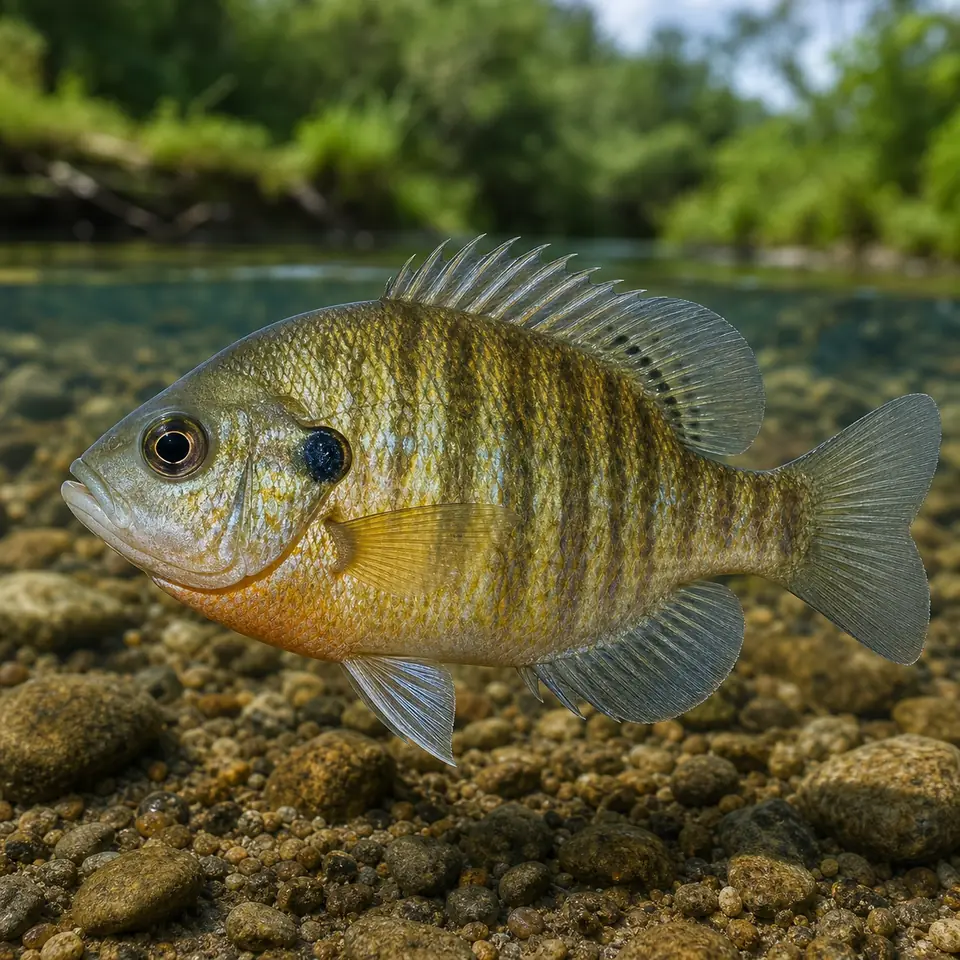
Work from stable structures to changeable details. First describe the overall silhouette: long and narrow, deep-bodied, laterally compressed, eel-like, broad-headed, disk-shaped, or built close to the bottom. Body shape can separate broad groups before you compare species names; a compressed sunfish-like body and a narrow pike-like body should not start in the same field-guide section.
Next inspect the head and mouth. Is the mouth terminal at the front, superior and angled upward, subterminal, or inferior and directed toward the bottom? Look for a pointed snout, a broad head, barbels, a beak-like mouth, visible teeth, or an unusually protrusible jaw.
| Trait | What to record | How it helps |
|---|---|---|
| Body profile | Long, deep, compressed, rounded, eel-like, or bottom-oriented | Places the fish in a smaller group before species comparison. |
| Mouth and head | Terminal, superior, subterminal, or inferior; snout, jaw, barbels | Separates feeding shapes and many close look-alikes. |
| Surface | Scales, plates, apparent scaleless skin, lateral line | Provides structure that is usually more stable than color. |
| Eye and head details | Eye position, cheek shape, gill cover, opercular marks | Can distinguish related groups when the silhouette is similar. |
| Habitat | Vegetation, shoreline, sand, reef, open water, tank, or bottom | Adds a range and behavior check without replacing anatomy. |
3 · Compare fin structure
Use fins, tail, and markings to narrow candidates
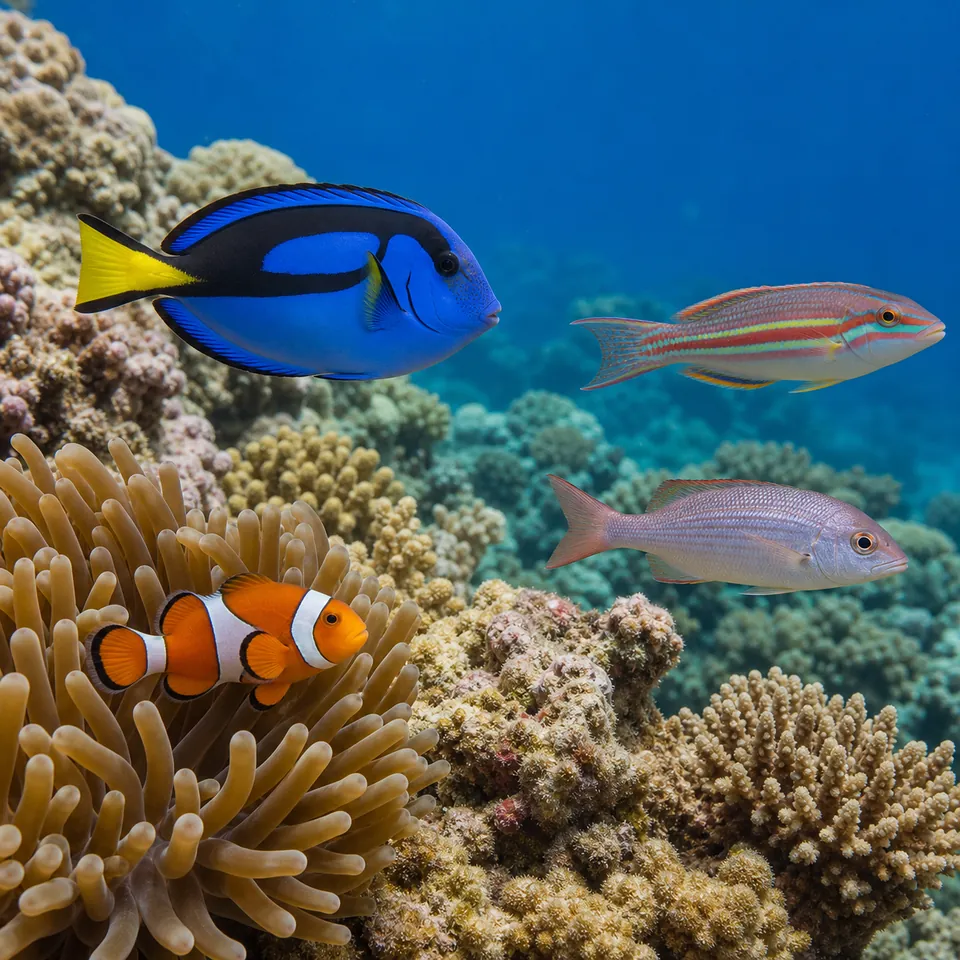
Fins are often more useful than a color match. Count the dorsal fins and note whether a fin has stiff spines, soft rays, a notch, or a continuous edge. Record where the dorsal, anal, pelvic, and pectoral fins sit in relation to one another. If the view is clear enough, describe the tail as rounded, squared, forked, deeply forked, or crescent-shaped. A fin that is hidden should be marked as unknown rather than guessed.
Then inspect markings on both sides. Note a lateral stripe, bars, spots, patches, an eye line, a contrasting tail, or a mark on the gill cover. Compare the marking boundary with body structure: a stripe crossing the eye is different from a line following the lateral line. Blue light, flash, reflection, and aquarium lamps can shift the shade, so pattern position and edge are usually more reliable than exact color.
| Area | Questions to ask | Common mistake |
|---|---|---|
| Dorsal fin | One fin or two? Spiny front? Deep notch? | Treating a folded fin as absent. |
| Tail | Rounded, truncate, forked, or deeply forked? Any spot or edge? | Using the tail color without checking its shape. |
| Paired fins | Where are pectoral and pelvic fins placed? | Ignoring them because they blend into the body. |
| Markings | Bars, spots, stripes, patches, eye lines, and both-side symmetry | Assuming a temporary shadow or reflection is a pattern. |
| Spines and rays | Stiff points or flexible branches? | Counting blurred fin rays as a precise number. |
4 · Eliminate look-alikes
Compare candidates with a regional fish key
Once you have a broad group, open a regional field guide or agency key rather than a random image search. A regional source reduces impossible candidates and shows local look-alikes. Start with Texas Parks and Wildlife freshwater resources or a local fisheries agency, then use a taxonomic database for the scientific name.
Make a three-column note: candidate, supporting traits, and contradictions. Record each candidate's body profile, mouth, scales, lateral line, fin arrangement, tail, markings, habitat, and range. Give contradictions real weight: an absent adipose fin, incompatible mouth, or impossible local range should lower confidence even when the color looks right.
Check the closest look-alike deliberately. Ask which feature separates the two species and whether it is visible. If not, keep both names. FishBase can verify taxonomic context, while local authorities are better sources for current distribution, protected status, or catch rules.
Use Fish Identifier for a photo starting point
Bass and sunfish
Compare body depth, joined dorsal structure, jaw reach, opercular flap, bars, and spots. Similar silhouettes are common, so region and mouth shape matter.
Trout and salmon relatives
Check streamlined profile, adipose fin, spot pattern, fin margins, age, and watershed. Color may change during spawning or with light.
Catfish and bottom fish
Look for barbels, a broad head, fin spines, a low swimming position, and tail or anal-fin shape. Never handle an unfamiliar spine.
Carp, minnows, and pond fish
Record scale pattern, mouth position, barbels, body depth, and lateral line. Stocking and aquarium releases can complicate range assumptions.
5 · State the limits
Record uncertainty and improve the evidence
A careful identification includes what you could not see. Mark the tail, fins, mouth, or markings unknown when the photo is dark, cropped, reflective, blurry, or partly hidden. Juveniles and breeding adults can differ in color and body form.
If you can safely take another image, use an evenly lit side view with the entire fish in frame, plus a three-quarter view when a fin is folded. Photograph the habitat separately. Do not touch venomous, spiny, protected, or unfamiliar fish for a better picture; reduce aquarium glass glare and protect yourself underwater.
Label the result as a family, group, or shortlist when species-level evidence is missing. Do not use a photo-only guess to decide whether a fish is safe to eat, legal to keep, protected, or invasive. Those decisions depend on current local rules and qualified authorities.
- Write the region, water type, habitat, date, and observation setting.
- Describe body profile, mouth, surface, lateral line, fins, tail, and markings.
- Keep two or three candidates and list both supporting traits and contradictions.
- Use a regional field guide before a worldwide image search.
- Mark any hidden or uncertain feature instead of filling it in from memory.
- Ask a fisheries agency, natural-history expert, or experienced local observer when the decision matters.
Fish species identification FAQ
Questions about identifying fish species
Short answers for anglers, aquarium hobbyists, students, and field observers.
What is the best way to identify a fish species?
Record the region and habitat, describe the body and mouth, inspect fins and tail, note stable markings, and compare two or three candidates in a regional field guide. Use a photo identifier as a starting point, not as the only authority.
Can I identify a fish from a photograph?
Often you can narrow a photo to a family or likely species when the full body, fins, head, and markings are visible. Poor focus, glare, juvenile color, hybrids, and close look-alikes can keep the answer uncertain.
Are fins more useful than color for fish identification?
Fin placement, spines, rays, tail shape, mouth position, and body profile are often more stable than exact color. Color can still help when you check it against structure, pattern boundaries, age, lighting, and habitat.
Why do I need a regional fish identification guide?
A regional guide limits the candidate list to species that can occur in the reported waters and usually shows the local look-alikes. A worldwide image search can make an attractive but impossible match look plausible.
Can fish species identification confirm a safe or legal catch?
No. A visual match does not confirm food safety, toxins, contamination, protected status, invasive status, size limits, or current fishing rules. Check official local guidance before making a safety or legal decision.
What should I do when two species still look the same?
Keep both candidates, list the feature that should separate them, and take or find evidence for that feature. If it is hidden or unavailable, report the identification at group level and ask a qualified local source.
Summary
A careful fish species identification workflow
Start with context, describe stable anatomy, compare fin and marking details, and then check a regional reference. Keep contradictions visible and state what the image cannot prove. That workflow turns “what fish is this?” into a useful, testable research question.
When you have a clear photo, use Fish Identifier to get a likely species, visible clues, possible lookalikes, and a practical next step. Then return to the field-guide checklist whenever a precise name matters.
Identify a Fish from a PhotoReference resources
NOAA repository — juvenile fish morphology field guide — A field guide resource that illustrates body orientation, mouth shapes, fin names, and tail shapes used in fish descriptions.
Texas Parks and Wildlife — aquatic species in fresh water — A regional public resource for freshwater species and local comparison material.
New York DEC — beginner freshwater fish guide — An introductory guide that explains how body shapes and local species context help beginners compare fish.
FishBase — global fish species database — Use it to verify a candidate scientific name and taxonomic context after narrowing the shortlist.